On January 4th, my friend Alexis (a humanities student) and I made the decision to go to the Chicago Cultural Center. We were originally planning on going to the Museum of Contemporary Photography, but we soon found out it was closed until the next
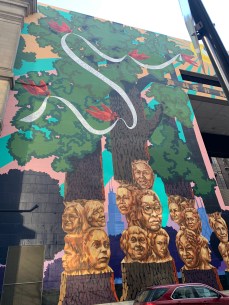
exhibition is finished. I decided to drive down to the city because I haven’t done much practice driving in the city so I figured it was a good opportunity. We got caught in a little bit of traffic so it ended up taking us about an hour to get there, but we soon arrived at our final destination on 78 E Washington St. Alexis and I were in high spirits when we got there because it was around 50 degrees outside and we were excited to be in the city. The cultural center had a beautiful mural on the side of the building so we stopped to take some pictures in front of it. Since the cultural center is free, we were able to easily walk in and start wandering around. We were taken back by the architecture inside the building and soon discovered that the building used to be a library.
We didn’t really know what to expect when we got there, so we were a little lost as to what we should do inside the cultural center. Since the cultural center provides a variety of different activities/exhibits, Alexis and I chose to go to an exhibit on the fourth floor titled, “African American Designers in Chicago”. The artwork and history present in the museum was very interesting and seemed to be promoting more black equality/recognition. This idea reminded me of a similar topic Peggy McIntosh touched upon in her article, White Privilege: Unpacking the Invisible Knapsack. In this article, Peggy discusses her overlooked advantage of her skin color. She mentions this when she says, “I have come to see white privilege as an invisible package of unearned assets which I can count on cashing in each day, but about which I was ‘meant’ to remain oblivious” (McIntosh 1). Peggy recognizes that she never did anything to earn the advantages she has every day against other races but that it’s society that has created this white power above blacks. She mentions that this white privilege is also unseen. It’s there and present but many people don’t want others to recognize or acknowledge it. They don’t want people to know that whites have all these extra advantages over others just because of their skin color.
I think this article connected to the exhibit because the museum did such a nice job at displaying the fact that black people obtain power too. It did this through the artwork,
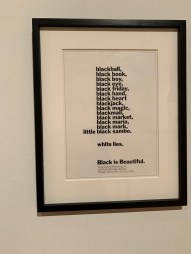
sculptures, readings, and history all present in the museum. One of my favorite pieces was a simple picture frame reading, “Blackball, black book, black boy, black eye, black Friday, black hand, black heart, blackjack, black magic, blackmail, black market, black maria, black mark, little black sambo. White lies. Black is beautiful.” I liked this picture because of its simplicity and the clear message that black is prominent in our everyday lives and is beautiful. The museum had me thinking of my own advantages because of my skin color and how I definitely take it for granted more often than I should.
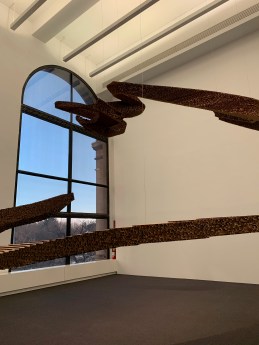
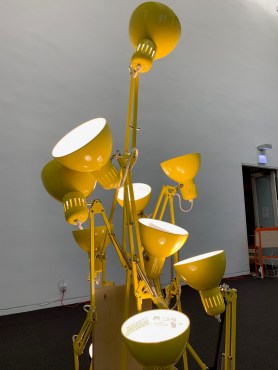
After Alexis and I explored the exhibit, we decided to go to another floor in the cultural center that was Chicago views and artwork. This floor of the cultural center was cool because again we were free to walk around anywhere we wanted and the artwork inside was very modernesque and funky. There were no descriptions of the different artwork so we were kind of left to ponder the meaning behind them. It was still fun to walk around and take pictures of the views outside as well as the artwork. I would definitely consider the Chicago Cultural Center to others who are looking for something to do. It is a great opportunity to go to the city and see a famous landmark as well as get educated about something new. It’s free and an extremely laid environment back which is the perfect combination.
 my world through my words